This is a follow up to an older article, which talked about the different variations of Colombian Spanish, with special emphasis on the difficulties of “Costeñol” dialect.
This article talks about MY personal Spanish language-learning journey to date, how I went from 0 Level (almost nothing, just a dozen or so words) to B1 Level (functional, albeit a bit shallow communication) of Spanish in a little over 3 years. I’ll also share what worked for me with regards to learning Spanish, as well as some general advice.
Language Levels
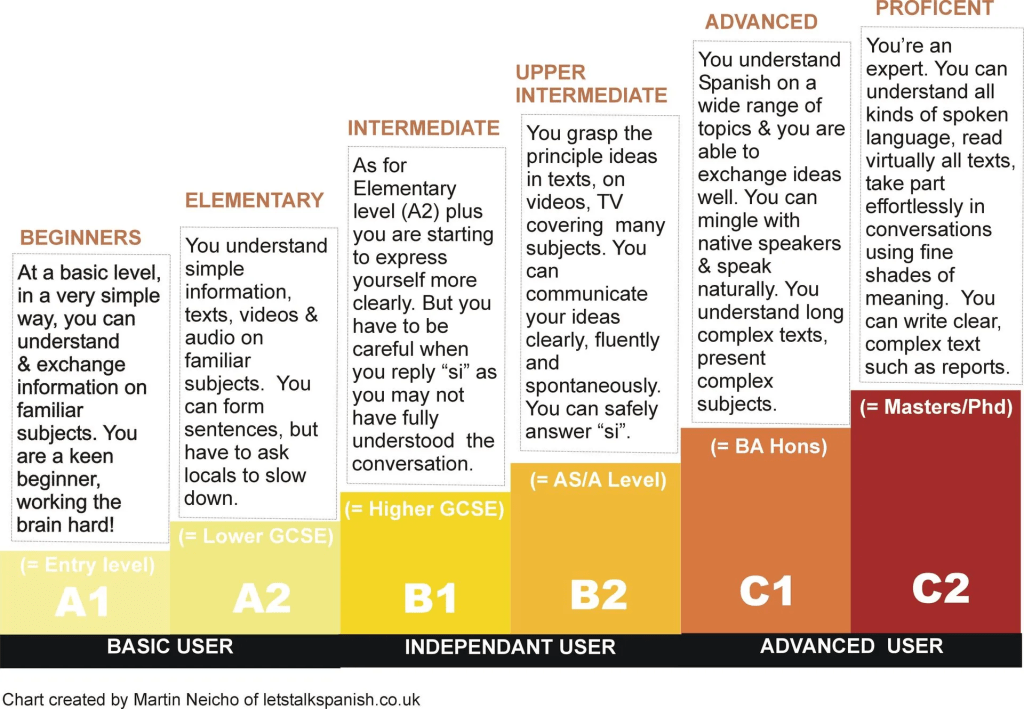
When I say, “B1 Level”, WTF am I talking about? Well, I am referring to the CEFR:
There are 6 Spanish levels determined by the Common European Framework of Reference for Languages (CEFR). These levels are expressed as A1, A2, B1, B2, C1, and C2. The CEFR Spanish levels are widely accepted as the global standard for grading an individual’s language proficiency.
Why, Where, and When I Started
My Spanish language-learning journey started in early 2021. I had decided to shake off the Pandemic Depression and travel to Colombia. Research showed that there were hardly any English speakers in Colombia, so learning Spanish was basically mandatory in order to do anything there, even as a tourist.
My knowledge of Spanish was limited to about a dozen vocabulary words (mostly learned from living in the Bay Area California for over 18 years), so I was basically at Level 0. I started playing around with random Spanish language apps, and Google Translate (more on those later). I also started intentionally listening to Spanish-language nursery rhymes and random phrases, to familiarize myself with the sounds and forms of the language.
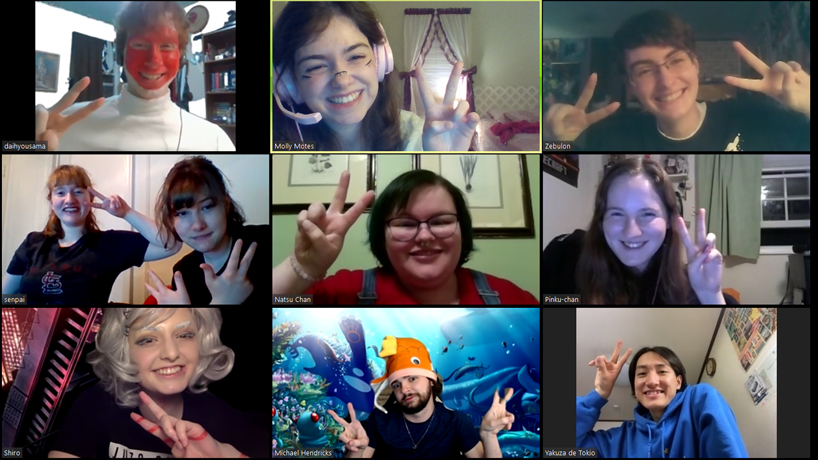
In addition to using software tools, I joined in free virtual Language Exchanges. This helped me practice what I was learning, as well as ask real-life people questions about various Latin American countries.
I talked to myself a lot, repeating Spanish phrases, inventing some of my own, and checking them for correctness on Google Translate.
Sometimes I would repeat Spanish phrases in front of a mirror, like a crazy person. Yes, the pandemic isolation was a bitch 😂 But we all knew that, so let’s talk about the apps and websites!
Language-Learning Apps
Over several weeks in June 2021, I researched and tried out over a dozen websites and mobile apps, checked their pricing models, and read reviews. To make a long story short, in the long run, I settled on Duolingo and Spanish Dictionary.
Why those two in particular? Each of these apps has its own specific way of “tickling my brain”, keeping me engaged and learning.
Duolingo is quite “gamified”, employing well-established psychological tricks to keep me engaged or even borderline addicted. And it works 😲 There’s a reason Duolingo is one of – if not THE – most popular “freemium” language-learning app in the world. To get the most out of Duolingo, I subscribed to Super Duo. It has been WELL WORTH IT, maintaining my 3+ year streak with a daily habit. Follow me (“ChineduOpa”) I always follow back.
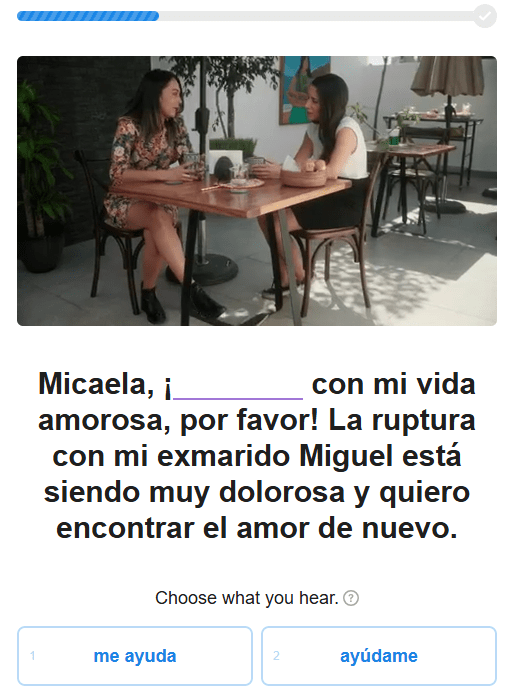
In contrast, Spanish Dictionary is less “gamified”, and has a “mature” and complete suite of learning tools, including grammar lessons, conjugation, pronunciation guides, in-depth and contextual translations, integration with Google Classroom, and more. Spanish Dictionary has so many free offerings, that I have not (yet) felt the need to upgrade to the Premium version.
Even though I was still researching various apps and learning methods, I started taking microlessons on July 1st of 2021, so I consider that day to be the beginning of my language-learning journey.
Other Apps and Websites
By the way, are Duolingo and Spanish Dictionary the ONLY recommended tools? No, not at all! Different people learn differently. Some people think Duolingo is too “gamified”, others think Spanish Dictionary is too boring… and that’s fine! Every individual should find whatever app works for them. The point is to use at least 2 apps/websites – along with other learning methods – and use them consistently, diligently, and at one’s own pace.

OK, enough of history and apps. How am I learning Spanish NOW?
Daily Routine
Many people have asked me, “How are you learning Spanish”? This schedule below describes the habit I developed, starting in 2021, and continuing up until the publishing of this article.
 | Mandatory ❗ In the morning, usually upon waking up, I take 15-30 minutes of Duolingo. I always do this between 6AM and Noon, so I get Double XP – cuz I’m addicted like that 😅 |
 | Mandatory ❗ During the day, I take 1 or 2 microlessons in Spanish Dictionary. Sometimes I go back and retake an older lesson, as a reminder, refresher, or reinforcement of certain concepts. |
| Mandatory ❗ During the day, I Read, Listen, Speak, and Write in Spanish. For output, I try to use whatever grammar or vocabulary I recently learned – this includes trying out synonyms and a different way of saying the same thing, and in the proper context. |
| Optional 💡 During the day, I memorize a new/difficult word or phrase. I challenge myself to use it in various sentences, then “check my work” in a translator, or with another person. This is how I learned words like “embotellamiento” (traffic jam). |
| Optional 💡 During the day I do some Spanish crosswords. I’ve been using Linguno a lot, but you can find many others online or in your app store. I find that repeating crossword puzzles is a good way to learn and reinforce new vocabulary, albeit without much context. |
 | Mandatory ❗ In the evening or at night just before bed, I take another 15-30 minutes of Duolingo between 6PM and Midnight… I gotta get that Double XP and stay in the Diamond League, fam! 😁 |
These MIGHT seem like a lot, but it really isn’t, especially since it’s a natural part of my routine and lifestyle. I’ve trained my brain to take advantage of any random 4-5 minutes of downtime – waiting in line, sitting on the toilet, etc. – and take a microlesson instead of fucking around on social media.

Of course, there are occasional days when I’m traveling, sick, or otherwise unable to do all the activities. During those periods, I still do the bare minimum – 1 microlesson in the morning, 1 microlesson at night – just to maintain my daily habit and Duolingo streak.
Challenges and Difficulties
I’ve already written at length about my difficulties with the Costeño dialect, so I won’t belabor the point here. However, I do face another challenge… and that’s the fact that I don’t do nearly enough listening (partly due to being discouraged by said difficulties with the local dialect). This means that I basically “gave up” on listening to regular people 😞 unless I absolutely have to (like the doctor or store clerk).
I do occasionally listen to podcast episodes, News on TV (without subtitles), or random clips on YouTube. Even though I can understand some of them – especially with repeated attempts – my Listening Comprehension remains my weak area, and I’m having difficulty getting THAT aspect past A1 Level.
Part of the issue is that I started learning Spanish via grammar, not by listening to native speech. My accuracy is relatively high, while my fluency is low-to-medium. So, while my output is often near perfect (albeit a bit slow), what I often get from native speakers is, “You Spanish is great! But we don’t say it like that. We usually say…” (and then they proceed to rattle of some street slang, weird grammatical structure, or esoteric expression that makes no sense to me 🤷🏾♀️😅).

While both accuracy and grammar both matter, I strongly believe in the mantra “Know the rules well, so you can break them effectively”. Therefore, I don’t regret learning and emphasizing Spanish grammar first, because this means I can input and output proper Spanish in isolation or communicate fairly well with other educated native Spanish speakers, while also adapting as-needed to the less-strict way that most other people speak.
Where I Am Now, What’s Next
My language-learning journey never ends. Well, at least not while I still have the desire and motivation to live in Latin America.
Like I said before, I know my Listening Comprehension is quite low. Therefore, I’ll be forcing myself to do a lot more Listening Comprehension practice. Obviously, it’s my least fun part of learning Spanish 😣 but I have no choice… I’ll set small goals and see how things go! 🤞🏾
Once I relocate out of this social hellhole called the North/Caribbean Coast of Colombia, I plan to enroll in an in-person Spanish Language academy to help me consolidate my existing skills, move me up a CEFR sub-level or two, AND hopefully socialize with more like-minded people.

Tips, Tricks, and Advice
Here are some general language-learning tips, tricks, and advice that have worked well for me throughout this journey.
- 💡 Get as much exposure as possible. In my case, exposure and practice come naturally – I live in Colombia and so I have full immersion. This means that I literally have no choice but to do input and output on a daily basis. There are other ways to maintain the language in your brain throughout the day. For example, consider changing your phone’s display to the target language. Many of us spend HOURS per day looking at our phones, so why not turn that mundane and frequent activity into a daily vocabulary reinforcement?
- 💡 Learn as much as you can. Not all vocabulary that you learn will be used in your daily output, and that’s OK! Yes, you should prioritize the “most common language elements”, so as to start communicating effectively sooner. However, don’t be afraid to “do more” occasionally. To put it simply: The more vocabulary you absorb, the greater will be your overall language comprehension.
- 💡 Repetition is your friend! Don’t be afraid to be “bored” by repetition. When you get “bored” with a phrase or concept, take a different TYPE of exercise or quiz and see if you pass it too. When you can effortlessly remember and use a phrase or concept, that means you’ve learned it!
- 💡 Beware of discouragement, inflated promises, and scams. Don’t pay attention to people who tell you “You cannot learn (language) with (tool)”, or people who tell you that you can “Learn (language) in 6 months”. More often than not, they try to SELL you a language-learning course. The truth is everyone learns differently, and at their own pace. The real master of the learning process and outcome is the STUDENT.
- 💡 Set small, realistic goals for yourself. Try not to think like, “I want to improve by one whole level within 6 months”. Instead think more like, “I want to learn and use one new common phrase every week”. More realistic, frequent goals to help you see progress and stay motivated.
- 💡 Identify and enjoy the “eureka moments”. Not long after I had learned the words “huelga” (strike) and “embotellamiento” (traffic jam), I was listening to national news (to train my ears, as usual). Suddenly my ears heard the word “embotellamiento”, my brain identified it, correlated it with a previous sentence that had “huelga”, and WOAH! I understood so much more of the newscaster’s non-stop chatter! I was so glad 😁👍🏾
- 💡 Push yourself but go at your own pace. You are the best master of your own motivations, capabilities, and schedule. In order to make progress, you have to put in the work without fail, but also prioritize according to YOUR unique needs and lifestyle. Don’t make learning an unpleasant obligation… your brain won’t learn as much, if at all. What I mean is…
- 💡 Have fun! It’s a well-known fact that people learn more when the activity is fun, funny, and engaging. This is why “gamified” apps like Duolingo are so popular: they work! There are many other websites that make language-learning fun, seek those out, and add variety and spice.
I certainly hope you got something out of this article. Good luck in YOUR language-learning journey!

 Opara's Journey