Usually whenever I go to a new country where I might settle, I try to “live like a local” (within reason, of course). Coincidentally, due to the difficulty in finding affordable short-term housing, I ended up spending almost my entire 2-month visit in a cramped 1-bedroom AirBnb in the south part of Santo Domingo Este, a relatively “ghetto” part of the city with a high population of Haitian refugees and illegal immigrants… most of whom don’t speak Spanish but French Creole.
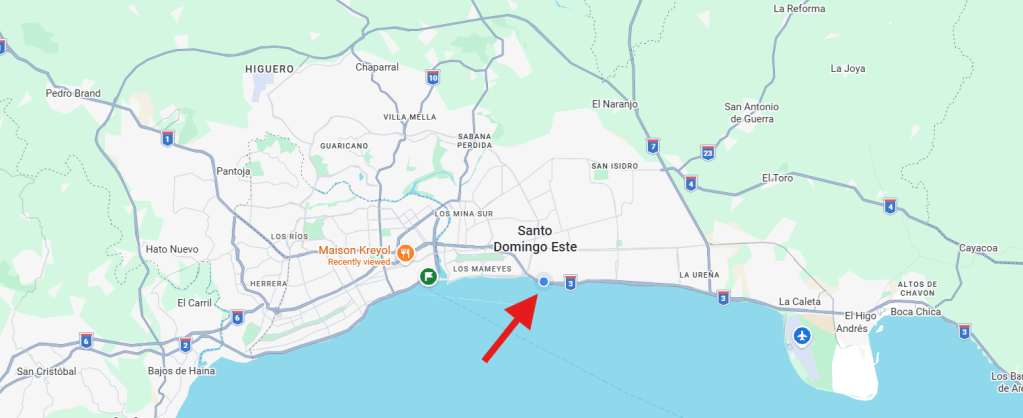
The area was walkable and accessible by public transportation and ride shares, but between the open gutters, smells and noise, it wasn’t exactly a place where I’d feel comfortable hanging out casually outside of my lodging. But I made it work for my brief stay, since I generally don’t go out alone much anyway.
Therefore, take this article with a big grain of salt… YOUR experience in Santo Domingo will most likely be much different if you say in classier, cleaner, more developed, more expensive part of the city.
This article will include some comparisons to Colombia and even the USA, because those are my frames of reference when it comes to long-term living.
- Cost of Living
- Language and Communication
- Housing
- Food
- Transportation
- Everyday Retail/Transactional Interactions
- Dating and Women
- Visiting and Overstaying
- In Summary
Cost of Living
I was ready for a higher cost of living in the Dominican Republic. After all, it’s a country mostly focused on tourism and vacations. However, I was quite unprepared for how MUCH higher it was than Colombia. Especially in the area of housing.
Even though I ate at restaurants on fewer than 6 occasions during my entire (I cooked and ate in my AirBnB, as is my habit), I found that my overall food spending was easily 3x what I was spending in Colombia. Yikes 😧
Every time I took an Uber or InDriver into the main city, I paid anywhere from 5 U$D during off-peak hours to 11 U$D or more during peak hours 🫢 These prices are at least double, often triple what I had gotten accustomed to paying in Colombia, thus severely limiting my outings.
Some other things were more affordable, however… the buses were less than $1 per ride, manicures were about 12 U$D, my simple haircuts were 5 U$D (including a tip), and simple street food (like 2 big pieces of fried chicken and some plantain or potato frieds) ranged from 3.50 U$D to 9 U$D.
Within my first 2 weeks, I realized very quickly that the Dominican Republic is NOT a budget-friendly destination 😅
Language and Communication
Many of the “regular people” – including educated people – speak Dominican Spanish, which is basically like freakin’ Costeñol, but even faster and with a whole different set of local expressions and vocabulary that don’t exist in any Spanish textbook or language-learning apps.
In fact, it gave me flashbacks to my awful 3 years in the north coast of Colombia where I was basically isolated in a luxury prison.
Just like in Colombia, here in Santo Domingo Este I found it quite difficult to carry on a 2-way conversation for any reasonable length of time with about 75% of the regular people like taxi drivers and even some store clerks. My most intelligible conversations were with, paradoxically, random Uber drivers from OTHER Latin American countries, and a couple of Haitian immigrants 🤷🏾♂️
Housing
Just like in Colombia, the Dominican Republic doesn’t have a centralized and updated database of housing options (like MLS or Apartments.com in the USA). Also, the few websites that claim to have apartment listings, are almost never updated nor accurate. So, visitors who want to rent a regular apartment without getting gringo-priced to hell, or paying premium to stay in AirBnBs forever, are forced to “hunt” far and wide via social media, word of mouth, and just walking around neighborhoods looking for For Rent signs and calling the numbers.
In other words, the least efficient way possible 🤦🏾♂️
By the way, I am low-key annoyed with all those travel bloggers and vloggers who talk about how they lived in $375/month apartments, etc., because they NEVER explain to the viewers HOW they found those places, and the realistic chances of success for OTHER apartment-seekers. I am hesitant to say that ALL those content creators are full of sh!t (only SOME are 😄)… but they are definitely misleading people with lack of relevant, “actionable” information about what is arguably the most important requirement for living abroad on a budget (second only to understanding the host country’s tourist and visa options). I found this out the hard way, unfortunately.
At least there are SOME vloggers who are more detailed, like this fella:
The difficulty of finding regular and affordable housing in Latin America is one of the biggest reasons that I am strongly considering seeking residency in other countries outside of this region.
Food
I tried some of the local Dominican cuisine, and I found it MUCH better than Colombian cuisine! While the local food here in the DR is only slightly more varied than that of Colombia, it is seasoned and significantly more flavorful. I found that whenever I ate at local kiosks, at restaurants, and even at the mall, I did NOT need to ask for condiments, nor did I need to whip out the bottle of hot pepper sauce that I usually carry around with me! Imagine that!
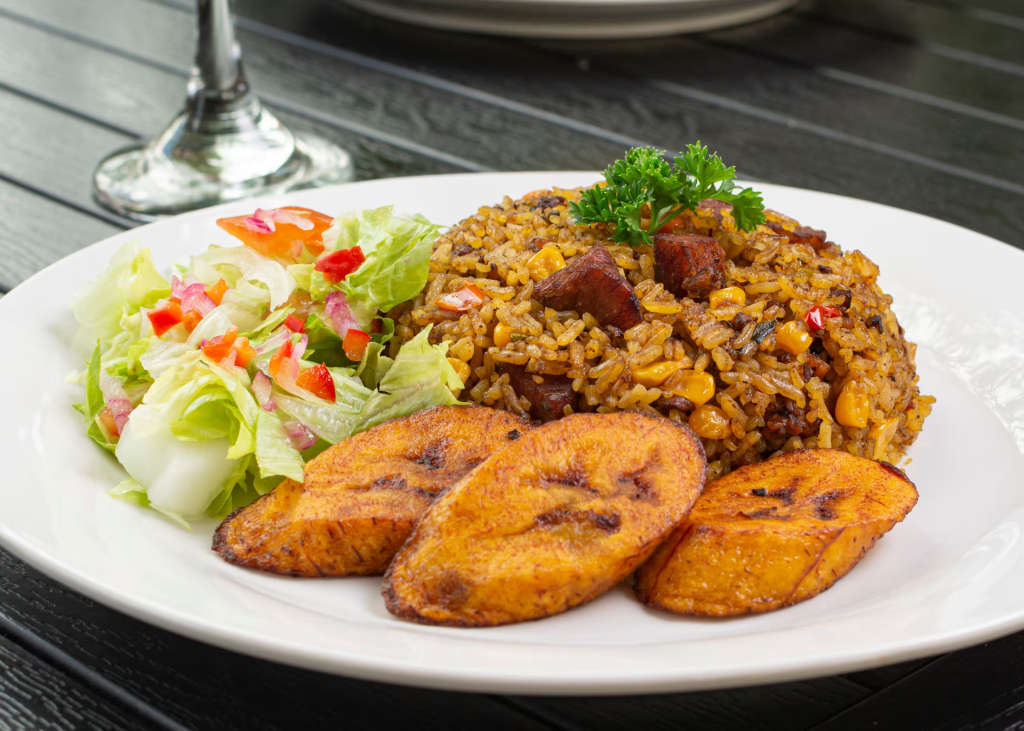
There is also a large Haitian presence here, which means access to Haitian “comida tipica”, which is in some ways even BETTER than typical Dominican food! In the first week of July, when my friend and I visited Sosúa, we had dinner at a nice outdoor Haitian joint called L’Auberge Creole Bar Restaurant. I had some delicious black rice with goat meat and plantain (I forgot the actual name of the dish). It was all so damn delicious! Click the link above for my full review and photos.
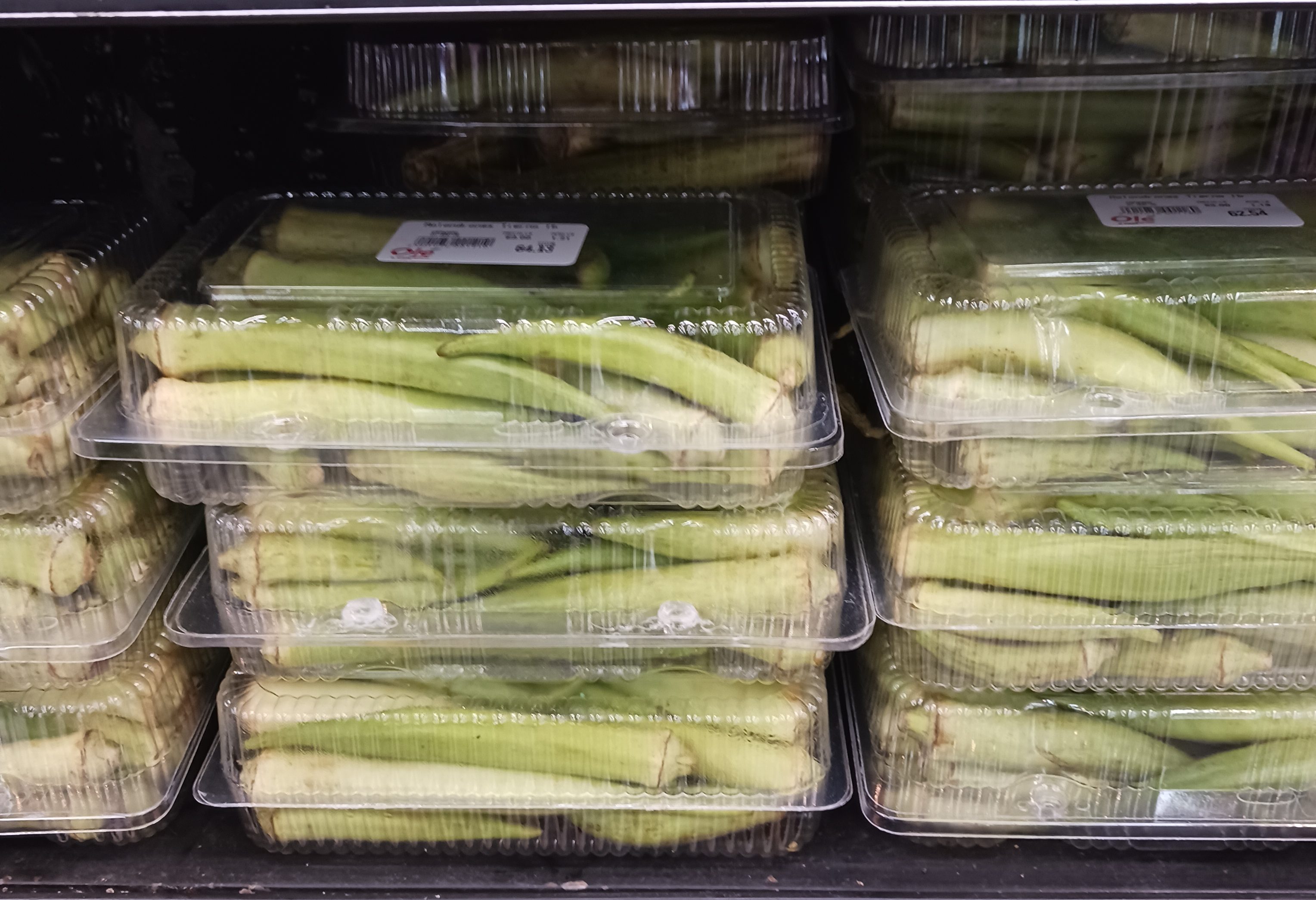
My only regret is that I didn’t explore the local cuisine more in Santo Domingo Este. I suppose I had already gotten into the habit of cooking and eating at home. However, based on my few dining experiences, my favorite dish is “mofongo”.
Transportation
Cars in the DR generally don’t mount their license plates in the front, only in the back. As you can imagine, this makes identifying your Uber/InDriver/Didi a bit tricky most times.
Many of the roads do not have crosswalks or traffic lights where you’d THINK they’d have them, though most do. Also, just like in Colombia, pedestrians have little or no rights on the roads, so it pays to be extra-vigilant when getting around on foot.
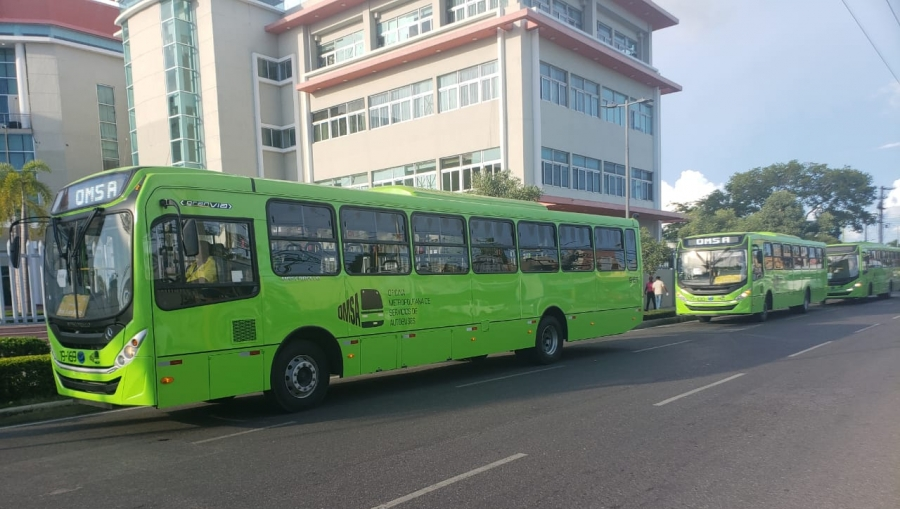
Living like a local includes using the bus system whenever possible. I did this a lot in Colombia, with great success. When I realized that I wasn’t going to stay in the Dominican Republic long-term, I didn’t bother learning to use the buses. However, from what I saw from the outside looking in, the regular city metro buses (“formal” buses) are just like those in Colombia and many other countries: you board, pay with cash or swipe your card, and go through the turnstile. I also saw that there were actual bus stops, and most of these bus stops showed up on Google Maps.
Directions and addresses can also be tricky, because not all residences have official addresses that are in the Maps or GPS databases. For example, the AirBnB where I was staying had a very confusing “address”, basically a couple of landmarks. Therefore, when using ride share apps, I just used the sports accessories shop diagonally in front of my building as the address.
Not surprisingly, the map and address confusion is most apparent outside of the more “developed” and “modern” parts of the city, so this is something to keep in mind when coordinating with people who live in the less-developed parts. It was especially challenging for me when almost all the locals I dealt with didn’t know how to read maps nor follow simple directions🤦🏾♂️
Everyday Retail/Transactional Interactions
In the USA and Colombia, I had gotten accustomed to business or retail staff greeting shoppers, visitors, or clients entering a business, even regular visitors. I’d also gotten accustomed to the usual “Here you go, thanks for shopping, have a good day” during and after paying for something at say, a grocery store.
However, this is NOT part of Dominican Republic culture nor retail/business training. I confirmed this online, and with my buddy who has lived in Santo Domingo for about a year.
I must have gotten a HINT of good service in the 100% tourist city of Sosúa, because they were clearly fishing for tips or trying to take advantage of someone they thought was a naive tourist. Not much different from Cartagena, Colombia. I also got the greetings a few times when I visited a mall in a nicer part of Santo Domingo. In most instances, the “Bienvenido” was delivered with all the enthusiasm of a terrorist hostage, and in other instances they only responded when I (or we, if I was with my buddy) looked at them directly.
Outside of those few instances of obviously fake or grudging greetings, I never experienced any routine “customer service” greetings.
The checkout staff at my local Supermercado Olé would routinely hand me my change or receipt without saying a word. Even when I tried twice and said “Gracias!” with full eye contact, I was just ignored the first time, and the second time I was given a strange look before they continued scanning items and yapping at full velocity with their coworkers 🤷🏾♂️ But of course, young men who were bagging items STILL expected tips 🙄
It’s not just supermarkets. Most restaurants are similar. For example, a local Haitian restaurant near my AirBnB low-key mistreated me upon my very first visit, prompting me to just leave after 2 minutes, and write a 1-star review on Google Maps. I am not sure if they thought I was looking for illegal Haitians in order to deport them, or what 🤷🏾♂️
At my local gym, Olimpus Gym Fitness (what a name, huh?), the staff doesn’t welcome nor say goodbye to clients, nor do they crack a smile in response to nice clients. At first I thought it was just my ugly old-man face that shuts them down 😆 but they seemed to treat all guests this way… no smiles, no welcome, just always on their phones, with occasional glances up at the security camera displays, or at clients when they sign in with their thumbs.
My local barbershop is similar… on my first visit, there was no welcome, no greeting, I had to basically “announce” myself and ask for a haircut. My greetings in Spanish were met with mostly blank stares or averted eyes, as if I were an extraterrestrial. Subsequent visits were a bit better, because the barber kid recognized me. And even though he didn’t smile nor say much, he at least acknowledged me… but any other clients would still give me the mostly-silent treatment. I am sure the language barrier had a lot to do with it (they seemed to only speak Haitian Creole, no Spanish, no English)… and they don’t know how to SMILE and welcome clients in spite of the language barrier. If even self-confirmed racist Chinese people can muster big (fake) smiles and use their 5 words of broken English to make clients feel welcome, surely Haitians can do the same, since we’re all black anyway?
Speaking of racial discrimination, I think there’s a deeper conversation to be had about how certain large groups of black people simply don’t have solidarity, nor do they welcome anyone that isn’t from their exact nationality and ethnicity. But I’ll leave that topic to a future article or other blogs.
Anyway, after all those unfruitful attempts at “normal everyday transactional politeness” in Santo Domingo, I gave the fuck up 🤷🏾♂️
At a certain point I started to miss the gregarious (albeit superficial) welcomes and greetings in everyday life back in Colombia. Oh well.
Dating and Women
I didn’t stay long enough to start going to any regular local activities where one could organically connect with “normal” (non-sex-worker) single women over shared interests. I did reinstall Tinder and Bumble, but of course the matches were basically 99% sex workers, scammers, super-entitled beggars, and maybe 1 or 2 “normal” women who I didn’t find attractive nor compatible. I deleted the apps.
In any case, since this country is primarily a tourism/vacation hotspot that is ALSO known for having some of the hottest women in the Americas, I assume that the mindset of “normal” women here is just like that of their counterparts in Colombia: they assume that ALL single male foreigners are here primarily for sex tourism, so they don’t bother engaging with us. I also assume that the mindset is MORE pervasive here in the DR than in Colombia, because the sex tourism industry here seems to be a much bigger percentage of tourism than it is in Colombia (that is, Colombia has several other major industries/exports besides tourism).
Visiting and Overstaying
This is where the Dominican Republic shines! Tourists from most countries get only 30 days, which most aspiring immigrants agree isn’t much. Many people end up overstaying, and paying a reasonable overstay fee upon exit, with no other penalties nor consequences. The fee amount is based on the length of the overstay (sliding scale).
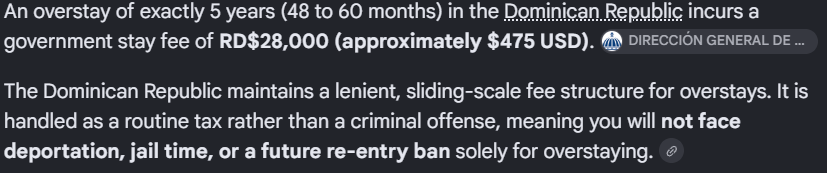
There are people who have come to the DR, stayed for upwards of 5 years, paid the overstay fee and left with ZERO problems. Me, personally, I overstayed by a month, so upon my exit, I paid 60 U$D at the airport, and continued on my way.
Compare this to Colombia’s rather hostile approach:
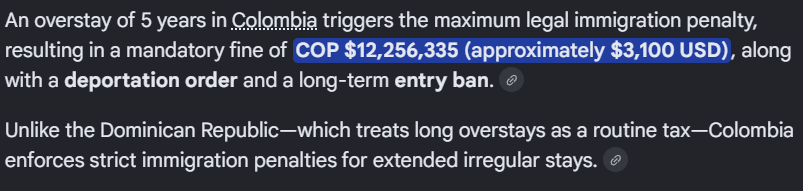
In fact, if you do the calculation, overstaying in the DR, even for 5 years, is far more cost-effective than applying for visas in Colombia (which would likely get denied anyway).
What a stark difference in how long-stay tourists and aspiring immigrants are treated in each country. The DR simply makes it easier to stay longer term – actually live here for a while, do a “trial run” without “watching the clock” and “dry-begging” for visas – BEFORE deciding if you want to stay apply for residency.
In Summary
The Dominican Republic has several positive things going for it, especially the generous/lenient overstay system that gives tourists “breathing room” to confirm that the country is a good long-term fit. It is also great for people who love the tropical weather, beach culture, and don’t mind the brief daily power outages.
However, for me personally, the Dominican Republic is NOT a good fit, mainly due to:
- Higher cost of living
- Difficulty of securing adequate housing
- Language barrier
That being said, I can see how the country is a very good option for MANY other people, including my friend who already lives here. And that is overall good news for this stable, fast-developing, lovely tourist/vacation destination.
Anyway… it’s a big world out there. Safe travels, everyone!